
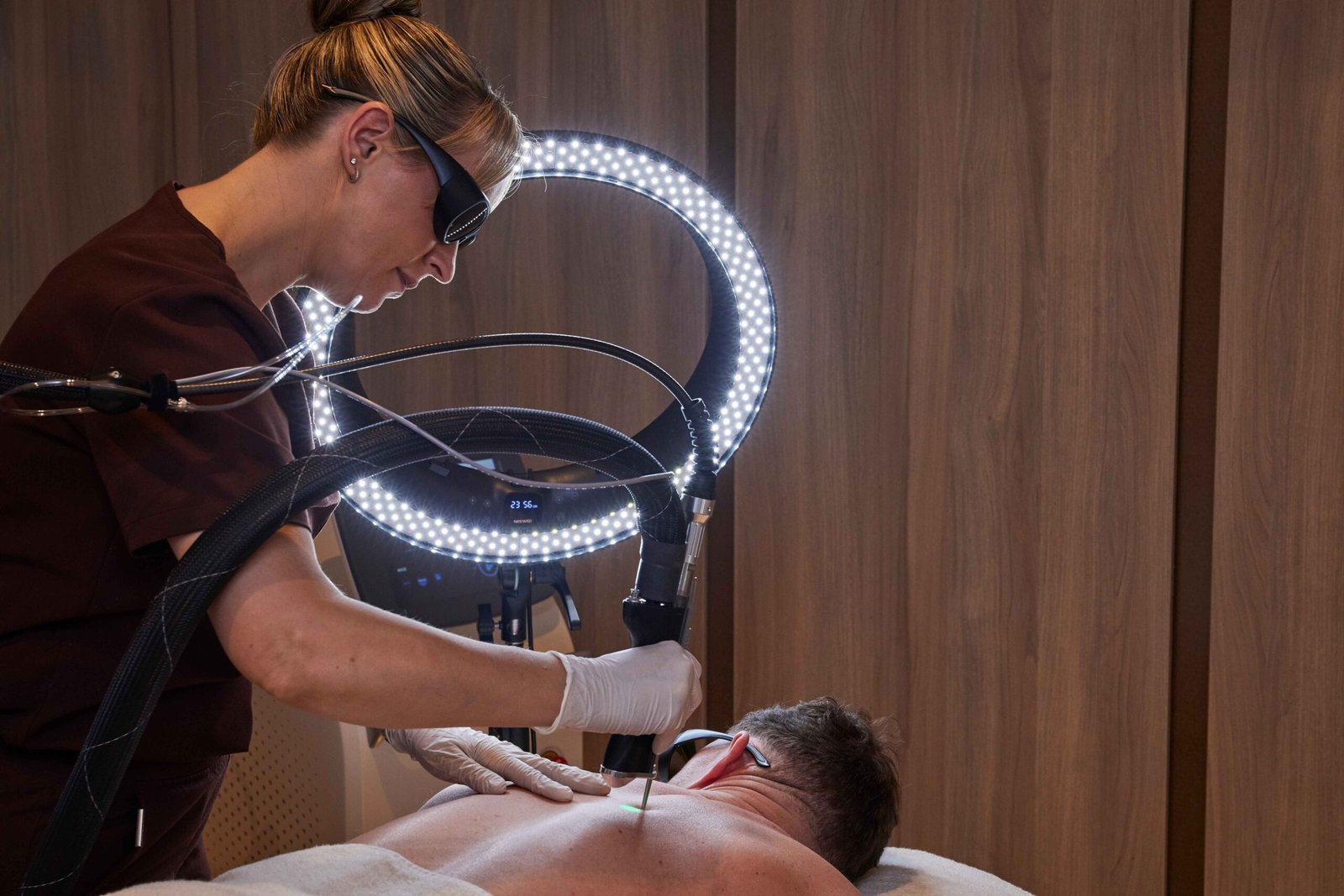
Full body laser hair removal for men is the biggest commitment on the laser menu. It’s the longest appointment, the most sessions, and the highest outlay, so it’s fair to want a straight answer before you book: is it actually worth it, or would you be better off treating one or two areas and leaving the rest?
The honest answer depends on how much hair you’re dealing with, how much time you currently spend managing it, and what “worth it” means to you. This guide walks through what a full body course involves for men, how long it takes, what drives the price in the UK, and the situations where it makes sense — and the ones where it doesn’t.
Why more men are treating the whole body, not just the back
Body hair removal stopped being niche a while ago. One UK survey cited by laser manufacturer Lumenis found that 46% of British men aged 16 to 24 remove hair from their bodies, and at our clinic the most popular men’s laser bookings are still the back and shoulders. What’s changed is that men who start with one area often come back for the next one, and the next, until they’re effectively paying for a full body course in instalments.
That’s usually the point at which a full body package starts to make more sense. If you know you want the chest, stomach, back, arms and legs done, treating them together in one appointment is cheaper per area, quicker overall and easier to keep to a schedule.
The other driver is practical rather than cosmetic. Coarse, dense male hair is the hair most likely to cause ingrown hairs, razor bumps and irritation after shaving or waxing. Men who lift, swim, cycle or simply sweat a lot in the summer often find that the maintenance is the real problem, not the hair itself.
What “full body” actually includes
This is where it pays to read the small print, because clinics define full body differently.
At Manchester Aesthetics, the full body laser hair removal session is booked as a single 75-minute appointment and covers the full legs, full arms, underarms and bikini line. The face is not included — beard shaping, neckline and cheek work are treated separately because facial hair grows on a different cycle and needs its own settings and spacing. Back, shoulders and chest can be added to your treatment plan alongside the full body session.
If a clinic advertises a “full body” price that looks remarkably cheap, check exactly which areas are in it. It’s common for the back, chest and face to be excluded and charged on top.
How many sessions does full body laser hair removal take for men?
Laser only works on hair that’s in its active growth phase, and at any one time only a proportion of your follicles are in that phase. That’s why one session never does the job — you have to go back at intervals to catch the follicles that were resting last time.
For most men, a full body course means six to eight sessions spaced four to six weeks apart. Men’s back and chest hair often needs more — eight to ten sessions isn’t unusual — because the hair is thicker, denser, and driven by testosterone, which keeps pushing new growth through for longer.
Here’s what a typical timeline looks like:
| Stage | What happens |
| Consultation and patch test | Skin and hair assessment, medical history, test patch on each body zone. At least 48 hours before the first treatment. |
| Sessions 1–3 | Hair sheds about 1–3 weeks after each visit. Regrowth is patchier and slower. Spacing: 4–6 weeks. |
| Sessions 4–6 | Noticeable thinning. Regrowth is finer and lighter. Spacing may stretch to 6–8 weeks as growth slows. |
| Sessions 7–8 (if needed) | Targets the stubborn follicles, usually on the back and shoulders. |
| Maintenance | A top-up session once or twice a year for most men. |
Realistically, that’s an eight- to twelve-month commitment from first session to finished course. Starting in autumn means you’ll be through the bulk of it before summer, which also makes it easier to keep treated skin out of the sun.
One thing to be clear about: no laser removes every hair for good. The NHS’s own patient information puts it plainly — complete removal cannot be achieved, and on average you can expect up to a two-thirds reduction in hair growth. A systematic review of long-term studies found reductions of between 35% and 84% with Alexandrite lasers and 30% to 74% with Nd: YAG, with leg hair responding best and facial hair least. What we aim for is long-term hair reduction: far less hair, finer and lighter, and a fraction of the maintenance.
How long does a full body session take?
The full body appointment at our clinic is booked for 75 minutes, which includes prep and aftercare. Larger or hairier areas take longer, and add-on areas extend the visit. Your first session tends to run longest because the practitioner is setting and checking parameters for each zone; later sessions are usually quicker.
The Cynosure Elite iQ Pro we use has a large spot size and integrated cooling, which is a big part of why a full body session is manageable in a single sitting rather than needing to be split across two appointments.
Also, read: Profhilo vs Polynucleotides: What’s the Difference and Which Is Right for You?
Does it hurt?
Most men describe it as a quick, hot snap — the NHS compares it to an elastic band flicked against the skin. It’s sharper on bony or sensitive areas (shins, the bikini line, the top of the shoulders) and easier on fleshy areas like the thighs. The integrated cooling on the Elite iQ Pro takes the edge off, and most people find the first session is the most uncomfortable because the hair is at its densest.
It’s not painless, and we won’t tell you it is. But it’s over quickly, and a full body course is generally far less unpleasant than years of waxing.
What affects the cost of full body laser hair removal in the UK?
We don’t publish full body pricing in this article because prices change and packages differ — you’ll get an exact quote at your consultation. But it helps to understand the market before you compare clinics.
Across the UK, full body laser hair removal for men typically sits between £300 and £600 per session, with a full course landing anywhere from £1,800 to £4,800 depending on the clinic. Course packages commonly run from £1,500 to £3,000 and almost always work out cheaper per session than paying as you go. London clinics sit at the top of that range; Manchester is generally more affordable.
What moves the price:
- Which areas are included. The single biggest factor. Check whether back, chest, and face are in or out.
- The laser. Medical-grade dual-wavelength systems cost clinics far more than IPL or single-wavelength diode machines, and that shows in the session price. It also determines whether the clinic can treat darker skin safely.
- Who’s doing it. A nurse-led clinic with a full medical consultation will price differently from a walk-in laser bar.
- Course versus pay-as-you-go. Buying a course usually saves 15–30% over single sessions.
- How many sessions you need. Dense back hair may push you past a standard six-session package.
Working out whether it’s worth it
Rather than looking at the headline course price, most men find it more useful to compare it against what they already spend and what it costs them in time.
| Shaving | Waxing | Full body laser course | |
| Typical ongoing cost | Razors, blades, products: £150–£300 a year | £50–£100 per full body wax, every 4–6 weeks | One-off course, then an occasional top-up |
| Time | 20–40 minutes, several times a week | 60–90 minutes every 4–6 weeks | 75 minutes, 6–8 times over a year |
| Ingrown hairs and irritation | Common | Common, plus folliculitis risk | Reduced as hair thins |
| Result | Regrowth in 1–3 days | Regrowth in 3–6 weeks | Long-term reduction |
Put a five- or ten-year horizon on that and laser usually comes out ahead on cost, and well ahead on time. Where it makes least sense is if you only have a couple of areas you actually care about — a back-and-shoulders course will be cheaper and get you 90% of the benefit.
Full body laser tends to be worth it if:
- You’re already treating or planning to treat three or more areas
- You get regular ingrown hairs, razor bumps or folliculitis
- You train, swim or compete and want a low-maintenance routine
- You’re spending on waxing every month
- You have dark hair and it’s dense enough that shaving leaves visible shadow
It’s probably not the right choice if:
- Your hair is blonde, grey, red or very fine — laser targets pigment and won’t work well on it
- You only want one or two areas done
- You can’t commit to sessions every four to six weeks for the best part of a year
- You have a holiday planned mid-course and can’t avoid sun on the treated areas
Is it safe for darker skin?
Yes, with the right laser and the right settings. Older machines struggled with darker skin because the laser couldn’t distinguish between pigment in the hair and pigment in the skin. The Elite iQ Pro’s 1064nm Nd: YAG wavelength is designed for exactly this, and its Skintel melanin reader measures your skin before treatment so the parameters are personalised rather than guessed. We’ve written a full guide to laser hair removal for darker skin tones if you want the detail.
Before and after your sessions
Preparation is simple but matters:
- Shave the areas 24 hours before. Not wax, not epilate — the laser needs the follicle intact. If you’re treating your back, the clinic can help.
- Stay out of the sun and off sunbeds for two to four weeks beforehand, and stop using fake tan. Tanned skin raises the risk of pigmentation changes.
- Tell your practitioner about any medication. Some antibiotics and acne treatments make skin light-sensitive, and isotretinoin is usually a reason to delay.
- Come in clean. No moisturiser, deodorant or oils on the day.
Afterwards, expect the skin to look pink and feel warm for a few hours, sometimes with small bumps around the follicles like a nettle rash. This settles within a day or so. For 24 to 48 hours, skip hot showers, saunas, the gym, and anything that makes you sweat heavily, and keep the areas out of the sun with SPF 30 or higher for the length of the course. The treated hairs shed over the following one to three weeks — leave them to fall out rather than plucking.
Side effects are uncommon when treatment is carried out properly but can include temporary redness, swelling, blistering or changes in pigmentation, particularly if skin has recently been tanned. This is why we patch test every zone before a full session, and why we assess your medical history at consultation.
What a full body course looks like at Manchester Aesthetics
Every men’s course starts with a laser and skin consultation at our clinic in Moston. We assess your skin type and hair, talk through which areas you want treated and whether full body or a combination of areas makes more sense for you, and carry out patch tests. There’s no pressure to book a course on the day.
Treatment is nurse-led and carried out on the Cynosure Elite iQ Pro, which combines 755nm Alexandrite and 1064nm Nd: YAG wavelengths so we can treat men of all skin tones safely. Results vary between individuals, and we’ll be honest with you at consultation about what you can realistically expect from your hair type.
If you’ve been searching for full body laser hair removal for men near you and you’re in north Manchester, we’re at 453 Lightbowne Road, M40 0HW, with free on-street parking. You can book a laser and skin consultation online, call us on 0161 222 3890, or read more about the best laser hair removal for men at the clinic.
